37期
案例分享
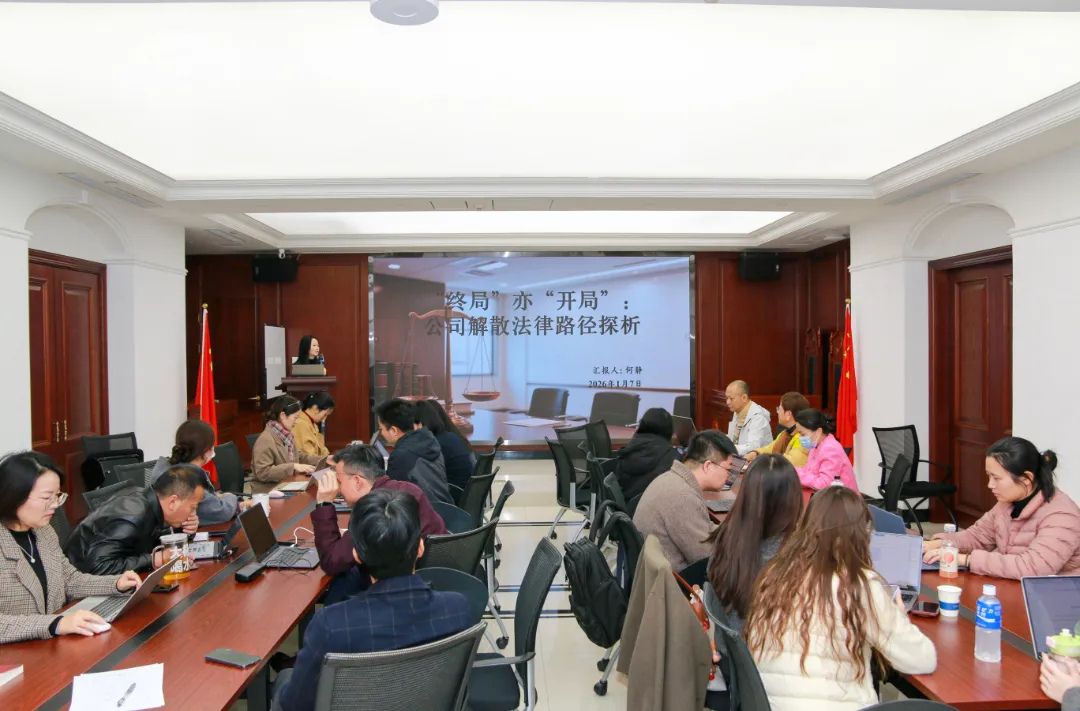
"Exit" is the final lesson in the corporate lifecycle. This learning and sharing session of the ChengGong Corporate Committee is presented by Lawyer He Jing. Based on the current Company Law, Lawyer He points out that corporate dissolution is not a verdict of business failure, but a legal procedure rigorously designed under the Company Law: it serves to terminate dysfunctional cooperative relationships while safeguarding the legitimate expectations of creditors, shareholders and transaction order. Delivering a presentation titled "The 'Endgame' Is Also a New Beginning: An Analysis of Legal Paths for Corporate Dissolution", Lawyer He Jing breaks down the complete legal journey from "endgame" to "new beginning" stage by stage along four phases: voluntary corporate dissolution, judicial dissolution, corporate liquidation and corporate deregistration.
ONEOverview of Corporate Dissolution
1.Definition: A legal act whereby a company ceases business activities and enters liquidation proceedings due to statutory or agreed causes.
2.Three key distinctions: Dissolution is not equivalent to deregistration (dissolution is a prerequisite for deregistration); the sequence is dissolution first, then liquidation, and deregistration last; after dissolution, the legal personality of the company remains intact, and the company may only conduct activities related to liquidation and shall not engage in new business operations.
3.Three types: ① Voluntary dissolution (causes stipulated in the articles of association, shareholders' meeting resolution, merger or division); ② Compulsory dissolution (revocation of business license, order to close down, or cancellation); ③ Judicial dissolution (shareholders petition the court for dissolution).
4.The "rescue rule" under the new law: Where a ground for voluntary dissolution has arisen but no property has been distributed to shareholders yet, the company may continue to exist by amending its articles of association or adopting a shareholders' meeting resolution; such resolution shall be passed by more than two-thirds of the voting rights (for a joint stock limited company, more than two-thirds of the voting rights held by the attending shareholders).
TWO Judicial Dissolution: Four Essential Elements, All Indispensable
1.Legal Basis: Article 231 of the Company Law; Article 1 of the Judicial Interpretation II of the Company Law.
2.Four Essential Elements:
Essential Element
Key Points for Practical Judgment
① Serious difficulties in operation and management
Check whether the governance mechanism fails: failure to convene a shareholders' meeting for two consecutive years or more / inability to form a valid resolution / long-standing conflicts among directors
② Continued existence will cause substantial loss to shareholders' interests
Misappropriation and loss of assets, risk of administrative penalties, potential safety hazards, and continuous erosion of residual value by costs
③ Cannot be resolved through other means
Share transfer, share repurchase, internal bidding, third-party mediation and other remedies must have been exhausted, with evidence retained.
④ Holding more than 10 percent of the voting rights
Determined based on the industrial and commercial registration and the register of shareholders; the transferee acquires equity upon entry in the register of shareholders; failure to fully pay the subscribed capital shall not affect the subject qualification.
Grounds for Non-Acceptance: Where a lawsuit is filed merely on the grounds of impaired right to know, impaired claim for profit distribution, corporate losses or insolvency, or revocation of business license without liquidation, the court shall not accept the case. Alternative remedies such as disputes over the right to know, liability disputes for harm to corporate interests, or applications for corporate liquidation shall be pursued instead (which are more likely to be upheld). Procedural Key Points: The plaintiff shall be a shareholder holding more than 10 percent of the voting rights, the defendant shall be the company, and other shareholders shall be third parties. The case shall be under the jurisdiction of the court at the company's domicile (the place of its principal establishment; if unclear, the registered address).
3、Comparison of Three Cases:
Case
Outcome
Key Points of Dispute
Case No. Hu 0105 Min Chu 21387
Dismissed
The company has surplus profits, there are communication records of the shareholders' meeting and dividends can be distributed — the governance mechanism has not failed, and the matter shall be resolved through share withdrawal or share transfer.
Case No. Yue 06 Min Chu 198
Judgment for Dissolution
The environmental impact assessment cannot be passed, the certificate has been cancelled, the business purpose is frustrated, the company suffers losses year after year and share transfer remedies have been exhausted — all three essential elements are satisfied.
Case No. Zhe 0921 Min Chu 1017 / Case No. Zhe 09 Min Zhong 646
Dismissed at both instances
The majority shareholder holding 60 percent of the voting rights can form resolutions; "failure to hold a written shareholders' meeting" does not equal "inability to convene such a meeting"; no proof that other remedies have been exhausted; exclusion from operation falls within the scope of shareholder autonomy.
Common grounds on which the court refuses to order dissolution: the shareholders' meeting or the board of directors is still functional; internal remedies have not been exhausted; no proof of substantial loss of interests; alternative remedies such as actions for the right to know are available; the loss of personal trust relationship shall not be easily found; no proof of serious operational difficulties; dissolution would endanger public interests.
4、Practical Suggestions:
1)Acting for the plaintiff shareholder: first verify the capital contribution obligation and the risk of subsequent supplementary payment; exhaust autonomous remedies and preserve evidence; apply for preservation as appropriate.
2)Acting for the responding party: prove that the governance mechanism remains operable and the company continues to operate (by means of contracts, financial statements, social insurance records, etc.), and proactively propose alternative solutions such as equity purchase and capital reduction.
THREE Corporate Liquidation
1. Positioning: a mandatory procedure from company dissolution to deregistration; its core is to sort out claims and liabilities and distribute remaining assets.
2. Three types of liquidation: voluntary liquidation (initiated by the company itself when assets are sufficient to cover debts); compulsory liquidation (applied when the liquidation group is not formed within the time limit, liquidation is deliberately delayed or liquidation is conducted in violation of the law, still on the premise that assets can cover debts); bankruptcy liquidation (adopted when assets are insufficient to cover debts or the company is obviously insolvent, to repay creditors fairly).
3. Procedures and time limits: ① Directors shall be liquidation obligors, who shall form a liquidation group within 15 days upon the occurrence of the dissolution cause → ② Notify creditors within 10 days after the formation of the liquidation group and publish an announcement within 60 days (in newspapers or the National Enterprise Credit Information Publicity System); creditors shall file claims within 30 days or 45 days as applicable → ③ Sort out company property and prepare balance sheets and property inventories → ④ Formulate a liquidation plan and submit it to the shareholders' meeting or the people's court for confirmation; the plan cannot be implemented without confirmation.
4. Three boundaries: the company still has litigation subject qualification during liquidation (represented by the person in charge of the liquidation group or the original legal representative); no business activities unrelated to liquidation may be carried out; no property may be distributed to shareholders before statutory repayment is completed
FOUR
Corporate Deregistration
1. Ordinary deregistration: applicable to all types of enterprises. Tax registration, enterprise registration and social insurance registration shall be cancelled in sequence; separate filing for deregistration is required for customs-related businesses. Required documents include an application form, dissolution or deregistration resolution, liquidation report or certificate of debt settlement, and tax clearance certificate.
2. Simplified deregistration: applicable to companies with no creditor's rights and debts or whose debts have been fully settled. The application shall be submitted within 20 days after the expiration of the public notice period, premised on a written undertaking from all investors, and the undertakers shall bear legal liabilities — procedures are streamlined, but liabilities remain unchanged.
3. Compulsory deregistration: applicable to companies that have not applied for deregistration three years after being revoked, ordered to close down or cancelled. An application for restoration of registration may be filed within three years after compulsory deregistration, and the registration authority may also restore the registration ex officio.
Key Takeaways
Dissolution is not equivalent to deregistration. Dissolution precedes liquidation, and the order cannot be reversed.
The company remains in existence after dissolution, but solely for the purpose of liquidation.
Voluntary dissolution may be stayed before voluntary distribution of assets — the window period is fleeting.
The four essential elements for judicial dissolution must all be satisfied cumulatively, and courts apply this remedy prudently.
"Exhaustion of other remedies" must be proven by evidence instead of being merely alleged.
Simplified deregistration streamlines procedures but does not exempt liabilities.
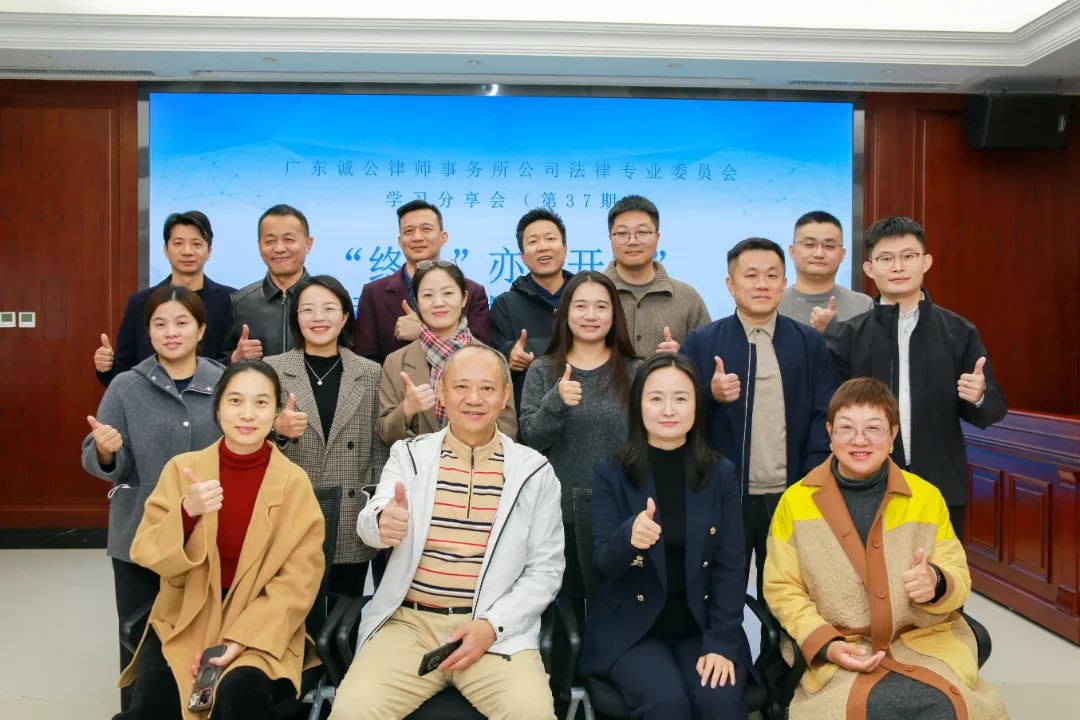
Group Photo for Commemoration
Speaker of This Session
Author: Dai Shaomei