Session 40
Case
Sharing
Acting as the nominal legal representative of a company may start out as merely "doing a favor". However, once the company falls into a debt crisis, the individual may be trapped by a consumption restriction order, unable to take flights or high-speed trains, and even facing impacts on their children’s education. When seeking to step down, the company refuses to cooperate, registration authorities decline to accept applications, and lawsuits get dismissed. Even after obtaining a judgment for registration removal, the consumption restriction order may remain in force. The difficulties for legal representatives in "resigning from the position" and "lifting consumption restrictions" have long troubled numerous parties and constitute a major pain point in enforcement practice.
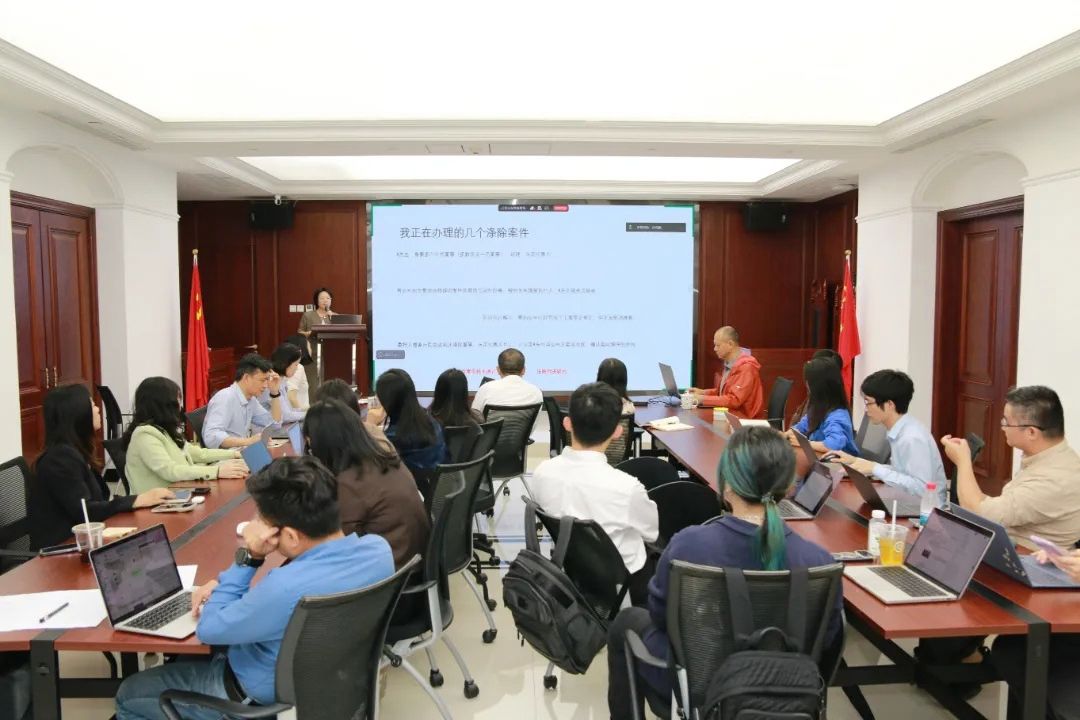
This session of the Chengong Corporate Committee Learning Sharing Session was delivered by Lawyer Jiang Haiyan. Drawing on multiple ongoing registration removal cases she is handling, Lawyer Jiang started with the institutional breakthroughs under the new Company Law and the latest judicial interpretations. She systematically sorted out the legal relationship between legal representatives and companies, the legal basis for exercising the right to resign, and adjudication rules for various registration removal disputes. Focusing on the predicament of removing the registration of legal representatives of companies listed as dishonest persons subject to enforcement, she analyzed judicial reasoning with multiple typical cases. On this basis, Lawyer Jiang further explained the subjects to whom consumption restriction measures apply, conditions for lifting such measures, application procedures and evidence preparation, providing a complete practical operation path for "registration removal and lifting of consumption restriction orders".
ONENew Rules and Institutional Background of Cases on Removal of Legal Representative Registration
1.The new Company Law opens a channel for the resignation of legal representatives
The Company Law of the People's Republic of China revised in 2024 (hereinafter referred to as the new Company Law) has made important adjustments to the legal representative system and provided a normative basis for resolving the "difficulty in resignation":
1、Article 10 of the new Company Law stipulates: Where a director or manager serving as the legal representative resigns, such resignation shall be deemed a simultaneous resignation of the legal representative. Where the legal representative resigns, the company shall appoint a new legal representative within thirty days from the date of resignation. This article establishes the resignation procedure for legal representatives, clarifies the effect of resignation and the company’s obligation to cooperate, and offers a remedy for the difficulty in stepping down.
2、Article 35 of the new Company Law stipulates: Where a company changes its legal representative, the application for change registration shall be signed by the new legal representative after the change. Together with Article 10, this article paves the way for the lawful change and removal of the legal representative.
2.Judicial Interpretation Draft for Comments Establishes Adjudication Rules
On September 30, 2025, the Supreme People's Court issued the Draft for Comments on the Interpretation of the Supreme People's Court on Several Issues Concerning the Application of the Company Law of the People's Republic of China. Article 1 thereof clearly stipulates important matters including adjudication rules, litigation procedures and liability bearing for the resignation or removal of legal representatives, comprehensively addressing many difficult issues arising since the implementation of the new Company Law:
Where a legal representative files a lawsuit against the company as the defendant, requesting confirmation that the resignation has taken effect and ordering the company to complete change registration or remove the registered information, the people’s court shall accept the case and render different dispositions based on the facts of the case: (1) If the company appoints a new legal representative within the period designated by the people’s court, the court shall order the company to apply to the registration authority for change registration; (2) If the company participates in the litigation but fails to appoint a new legal representative within the period designated by the people’s court, or fails to participate in the litigation, the court shall order the company to apply to the registration authority for removal of the registered information; (3) Where laws and administrative regulations contain special provisions governing the resignation or departure of legal representatives, the court may dismiss the claim in accordance with such special provisions.
Meanwhile, this article also clarifies: Where the people’s court orders the company to complete change registration or remove the registered information, it shall simultaneously confirm that the legal representative has resigned as of the date when the company receives the written resignation notice. The resignation or removal of a legal representative shall not affect the liabilities that the legal representative shall bear for acts committed during the term of office.
3.New Civil Cause of Action: "Dispute over Removal of Corporate Registration (Filing)"
In 2025, the Supreme People's Court issued the Decision on Amending the Provisions on Causes of Action in Civil Cases, which shall take effect on January 1, 2026. Under the third-level cause of action "292. Dispute over Request for Change of Corporate Registration", this Decision adds "(1) Dispute over Removal of Corporate Registration (Filing)". The addition of this cause of action marks that disputes concerning removal of legal representative registration have obtained a clear position in the civil cause of action system, making the litigation path for parties more definite.
TWO Legal Relationship between Legal Representatives and Companies
1. Qualifications of Legal Representatives: Dual Status and Substantial Connection
Pursuant to Article 10 of the new Company Law, a legal representative must hold dual status. The prerequisite for such appointment is to serve as a director or manager who conducts affairs on behalf of the company, reflecting strong status dependency. It should be noted that the legal representative constitutes a corporate registration item, while directors or managers are filing items. Loss of the position as director or manager directly results in the termination of the status of legal representative; the two are in fact two sides of the same coin.
At the same time, the new Company Law emphasizes that a legal representative shall "conduct affairs on behalf of the company", and possess both internal management capacity and external representation capacity. The lack of substantial connection of a nominal legal representative may serve precisely as the core ground for registration removal.
2. Compound Nature of Mandate Relationship: Mandate as the Core Foundation
The mandate relationship between a legal representative and the company encompasses the contract of mandate governed by the Civil Code and the organizational relationship regulated by the Company Law, among which the contract of mandate constitutes the core foundation.
In terms of establishment basis, the appointment of a legal representative requires provisions in the company’s articles of association (reflecting shareholders’ will) and consent from the selected person. It conforms to the principle of consensus of contractual declarations of intent and shares the characteristics of the formation of a contract of mandate. From the perspective of conduct pattern, the relationship between both parties satisfies the features of a mandate contract including service as the subject matter, personal trust, and being a consensual and informal contract. Handling corporate affairs by the legal representative is essentially a mandated service act.
In addition, the mandate relationship may incorporate statutory powers under organizational law, and a labor contract relationship may even coexist. Nevertheless, the contract of mandate always determines the foundation of rights and obligations, and the exercise of the right to resignation is still based on the unlimited right of termination under the contract of mandate.
3. Resignation Constitutes Exercise of the Right to Unilaterally Terminate the Mandate Contract
Pursuant to Article 933 of the Civil Code, both parties to a mandate contract enjoy the right of arbitrary termination and may terminate the mandate relationship at any time. The core reason why legal representatives and directors have such right lies in that a mandate contract is built on mutual trust between the principal and the trustee. Where such trust foundation no longer exists, granting the right of arbitrary termination conforms to the nature of the mandate relationship and protects both the company’s interests and the legitimate rights of legal representatives and directors.
In respect of the form and validity rules of resignation, legal representatives and directors shall notify the company in writing and clearly express their intention to resign. Resignation takes effect on the date when the company receives the written resignation notice and does not require consent or approval from the company. Under Paragraph 2 of Article 10 of the new Company Law, the resignation of a director serving as the legal representative is deemed simultaneous resignation of the legal representative, and the two statuses are bound together.
THREE Legal Relationship between Legal Representatives and Companies
1. Adjudication Rules Established by the Draft for Comments
Pursuant to Article 1 of the Draft for Comments, the general adjudication rule for registration removal lawsuits may be summarized as follows: Where a legal representative institutes an action against the company as the defendant, requesting confirmation that the resignation has taken effect and ordering the company to complete change registration or remove the registered information, the people's court shall accept the case. If the company appoints a new legal representative within the period designated by the people's court, the court shall order the company to apply for change registration. If the company participates in the litigation but fails to appoint a new legal representative within the designated period, or does not participate in the litigation, the court shall order the company to apply for removal of the registered information. Where laws and administrative regulations contain special provisions on the resignation or departure of legal representatives, the court may dismiss the claim in accordance with such special provisions.
2. Removal Rules for Falsely Registered Legal Representatives
Nominal registration by impersonation lacks a legal basis, and review shall be conducted from both positive and negative dimensions: first, whether the fact of impersonation registration is established; second, whether the party concerned had knowledge.
At the formal level, whether the signatures on registration documents (including shareholders' meeting resolutions, articles of association and application forms) were affixed by the person himself/herself serves as an important basis, and certificates of lost or stolen identity cards constitute strong supporting evidence. At the level of substantial connection, the subjective state shall be determined by taking into account the relationship between the impersonated person and the perpetrator, existence of equity or capital transactions, participation in company operation and receipt of remuneration. Once the fact of impersonation registration is confirmed, the impersonated person has never held the status of legal representative and shall not bear relevant liabilities.
3. Removal Rules for Nominal Legal Representatives
Two scenarios shall be distinguished for nominal legal representatives:
Ordinary nominal legal representatives: Where they have no substantial interest connection with the company and do not participate in actual operation, their claim for registration removal shall be upheld after exhausting internal remedies (such as submitting a resignation request to the company). A typical case is Zhang v. a real estate development company in Langzhong.
Professional nominal legal representatives: They seek to evade legal liabilities, receive remuneration without participating in operation, demonstrating obvious bad faith and severe harms to the market. Judicial practice consistently rejects their applications and will not grant registration removal. A typical case is Zheng v. an investment management company.
4. Removal Rules for Legal Representatives with Substantial Connection
1)Director-Manager Type: The status of legal representative is dependent on the position of director or manager. Resignation as a director or manager shall be deemed simultaneous resignation of the legal representative. Where there is only one director or the director concurrently serves as the manager, resignation from both the director and manager positions is required for registration removal.
2)Shareholder Type: Substantial connection is determined based on the shareholding ratio and the degree of influence over shareholders' meeting resolutions. Registration removal may be granted where the individual holds a low proportion of shares, does not participate in business operations and has exhausted internal remedies (e.g. failure to pass a resolution after convening a shareholders' meeting).
In terms of typical cases, in the case of Sheng v. a Chengdu education investment limited company, the court rejected the claim for registration removal on account of the substantial connection between the claimant and the company and the absence of a change resolution. By contrast, in the case of Chen Feifei v. a Shanghai decoration limited company, the court upheld the claim for registration removal after the plaintiff exhausted internal remedies.
FOUR
Special Rules on Removal of Registration of Legal Representatives of Companies as Dishonest Persons Subject to Enforcement
1. Two Viewpoints and Adjudication Reasoning
Where a company has been included in the list of dishonest persons subject to enforcement, the registration removal application filed by its legal representative faces stricter review, and two viewpoints exist in practice:
Viewpoint 1: Registration removal shall in principle be denied based on the principles of good faith and assumption of risk. This view holds that except for impersonation registration, all legal representatives bear corresponding liabilities for the company’s dishonesty. Even for ordinary nominal legal representatives, they shall bear corresponding legal consequences under the assumption-of-risk doctrine. Where the company is listed as a dishonest person subject to enforcement, the court may dismiss the lawsuit on the ground that the legal representative lacks "litigation interest".
Viewpoint 2: Support registration removal for persons without substantial connection through comprehensive value balancing. This view maintains that it is necessary to balance the personal freedom of the legal representative, judicial enforcement, administrative supervision, and the interests of the company and creditors. If the legal representative can prove that he is merely an ordinary nominal representative without actual management power or liability for the debts, and has no intention to evade enforcement, and can identify the actual actor or controller, the court may grant registration removal.
Current judicial practice generally adopts the principle of interest balancing to examine the liability status and actual control situation of the legal representative. It shall be particularly emphasized that removal of registration does not necessarily lift the company’s dishonest status or the consumption restriction order imposed on the legal representative. Compliance with Article 10 of the Provisions of the Supreme People's Court on Several Issues concerning the Publication of Information on the List of Dishonest Persons Subject to Enforcement and relevant effective judgments is required to ensure that the registration removal system will not become a tool for evading enforcement.
2. Typical Case Analysis
Case 1: The plaintiff remains a registered shareholder with substantial interest connection and has not exhausted remedies — registration removal is not upheld
A company was established on March 2, 2017, with a registered capital of RMB 1 million. Its registered shareholders were Bao (holding 1% of shares) and Yang (holding 99% of shares). Bao served as the legal representative, executive director and general manager. As the company failed to perform the payment obligations specified in the effective legal documents, it was included in the list of dishonest persons subject to enforcement and subject to high-consumption restrictions. Bao, as the legal representative, was designated as the related person subject to such high-consumption restrictions. On December 25, 2021, Bao and Yang signed a Shareholders’ Agreement, stipulating that Yang shall complete the change of Bao’s status as legal representative and shareholder before December 30, 2021. Since the agreement was not performed, Bao filed a lawsuit.
The court held: The appointment and removal of a company’s legal representative, executive director and general manager fall under internal corporate governance matters and shall be determined by the company’s authority. Judicial power shall not intervene absent special circumstances. Based on the available evidence, Bao was registered as a shareholder with the administrative authority for industry and commerce and maintained substantial interest connection with the company. The evidence submitted was insufficient to prove that he had exhausted all possible internal remedies, so the claim for registration removal was rejected.
Takeaway: Even if a "nominal representative agreement" is signed, the claim for registration removal may still be dismissed so long as the individual remains registered as a shareholder and fails to exhaust internal remedies.
Case 2: The Plaintiff Actually Participated in Operation and Management, and the Company Did Not Elect New Directors — Registration Removal Is Not Upheld
Chen Jiaming served as the chairman and legal representative of Company B, and also acted as the legal representative and executive director of a Hong Kong company holding 50% equity in Company B. On November 14, 2024, Chen Jiaming sent a Statement of Resignation of Legal Representative to Company B. Company B has now been listed as a dishonest person subject to enforcement.
The court held: First, the Payment Application Forms on file and statements made during the trial show that Chen Jiaming participated in the operation and management of Company B and the management of its company seal. His allegation that he had no substantial connection with the company’s operation and management is inconsistent with the facts. Second, even if Chen Jiaming’s term of office as chairman expired, there is no evidence showing that the company has elected a new chairman or that a shareholders’ meeting cannot be convened for such election. Therefore, he shall continue to perform his duties as a director. Pursuant to the articles of association, the legal representative shall be assumed by the chairman. Third, legal representatives and directors with substantial connection to corporate operation and management play an important role in the company’s performance of debts and protection of the legitimate rights and interests of creditors. The registration removal of directors and legal representatives concerns not only the termination of the mandate relationship, but also requires the company to internally form a resolution or elect a successor, and then apply for change registration in the company’s name.
Takeaway: Where the person actually participates in operation and management and the company fails to elect a successor, courts tend to deny registration removal so as to maintain the continuity and stability of the company’s governance structure.
Case 3: The Plaintiff is a Nominal Legal Representative without Substantial Connection with the Company — Registration Removal Is Upheld
The plaintiff was an employee of an unrelated company from March 1, 2013 to January 31, 2020. To do the defendant a favor, the plaintiff became its nominal legal representative on January 25, 2016, holding no actual position and never participating in management. As the defendant was involved in external debt disputes, the plaintiff was subject to consumption restriction measures imposed by the court. On December 3, 2024, the plaintiff served a resignation letter on the defendant, yet the defendant failed to fulfill its obligation to complete industrial and commercial change registration.
The court held: First, the plaintiff served merely as the nominal legal representative to help the defendant, which was acknowledged by the defendant. The plaintiff was not a shareholder of the company, and no evidence indicates a labor contract relationship between the parties or that the plaintiff received remuneration. There is no substantial connection between the plaintiff and the defendant. Second, the purpose of imposing consumption restriction measures on the legal representative when the company is listed as a dishonest person subject to enforcement is to prevent the company from passive performance, evasion of enforcement or resistance to enforcement. Such measures are not personal in nature. Where the plaintiff lacks substantial connection with the company, removal of the legal representative registration will not harm the interests of the company’s creditors. Third, after the plaintiff’s resignation, the company has failed to appoint a successor legal representative or executive director, leaving the plaintiff unable to handle change matters through corporate autonomy. The judgment upheld the claim for registration removal.
Takeaway: Claims for registration removal may be upheld for ordinary nominal legal representatives who have no substantial connection with the company, have tendered resignation, and face non-cooperation from the company in completing change procedures. Such registration removal itself will not impair creditors’ interests.
FIVE
Procedural Coordination and Enforcement of Lawsuits for Removal of Registration
1. Conditions for Institution of Action and Identification of Parties
In respect of the plaintiff and claims for action, the plaintiff is usually the legally registered legal representative of the company. Under special circumstances, company shareholders who assign employees to serve as legal representatives may also be qualified plaintiffs. The causes of action are mostly "dispute over request for change of corporate registration" or the newly added "dispute over removal of corporate registration (filing)". The claims usually request the court to order the company to change or remove the plaintiff's status as legal representative, and may include requests to confirm the validity of resignation or the validity of company resolutions depending on case types.
In respect of defendants and third parties, the qualified defendant is the company, and generally only the company shall be listed as the defendant. In impersonation registration disputes, the perpetrator of impersonation may be listed as a defendant or third party; in nominal registration disputes, the actual controller may be listed as a third party; for substantial connection disputes involving the appointment of a new legal representative, the new legal representative or directors and managers eligible for succession shall be listed as third parties.
To avoid "self-dealing representation" or "dual representation", the people's court shall require the company to separately appoint a litigation representative in the following order: in accordance with the provisions of the articles of association; absent such provisions, the chairman, vice-chairman and directors (through negotiation or court designation) in sequence; if no suitable candidate is available from the board of directors or directors, the chairman of the board of supervisors or a supervisor shall be designated, and where there are no supervisors, the manager or the person in charge of the audit committee shall be designated.
2. Pre-trial Designation Procedure
The Draft for Comments designs a "pre-trial designation procedure", whereby the court, after accepting the case, sets a certain time limit and requires the company to appoint a new legal representative. This procedure serves to urge normally-operating enterprises and can advance litigation proceedings.
In terms of applicable rules: No designation is required where the company cannot be located or refuses to participate in litigation, or in impersonation registration removal lawsuits (except for change upon consensus of the parties). The designated period is set as 30 days by reference to Paragraph 3 of Article 10 of the new Company Law, which may be extended under special circumstances and such extension shall not be counted within the trial period. Designation is effected by written notice from the court, which may be served together with the copy of the statement of claim. In respect of procedural effect, if the company appoints a new legal representative within the designated period and completes change registration without obstacles, the litigation shall terminate; if obstacles exist, the claim may be amended; if no new legal representative is appointed, the court shall order removal of the registered information.
Regarding whether the legal representative registration may be left vacant: The duties of legal representatives are weakened under modern company law, and operational management powers are mostly exercised by directors or managers. Vacant registration does not necessarily impair the company’s transaction efficiency. Instead, it can urge the company to improve its governance and warn of market risks. The Measures for the Implementation of the Administration of Company Registration also provides the basis for administrative authorities to cooperate with registration removal. Therefore, legal representative registration may be left vacant.
3. Determination and Enforcement of Judgment Items
With regard to the content of judgment items, for impersonation registration removal lawsuits, the court shall first confirm that the plaintiff has never held the status of legal representative, and then order the removal of registration. For resignation-based registration removal lawsuits, apart from ordering registration removal, the judgment shall specify that resignation does not relieve the legal representative of liabilities incurred during the term of office. Judgments for change of registration shall include the time limit for performance, the change of registration and the effective date of resignation, and may order third parties with the obligation of assistance to complete relevant procedures.
As for the effective date of resignation, resignation shall take effect when the written declaration of intent to resign by the legal representative reaches the company. This conforms to the rule that termination notice takes effect upon receipt under the Civil Code and the provisions of Paragraph 3 of Article 70 of the new Company Law governing the effective date of director resignation. It shall be noted that the taking effect of resignation does not equate to exemption from liability, and liability shall still be assessed based on the period of actual tenure.
In terms of enforcement, Article 23 of the Measures for the Implementation of the Administration of Company Registration, which took effect on February 10, 2025, clearly stipulates: Where a company fails to perform statutory obligations concerning registration (filing) matters specified in effective legal instruments within the time limit, and the people’s court serves a notice of assistance in enforcement on the company registration authority to request assistance in removing information of legal representatives, directors, supervisors, senior management personnel, shareholders, branch company persons-in-charge, etc., the company registration authority shall publicly announce the removal information to the society through the National Enterprise Credit Information Publicity System in accordance with law. This provision removes obstacles to the enforcement of registration removal judgments. If the company refuses to perform the obligation of change registration, the court may impose fines on the company in accordance with relevant provisions of the Civil Procedure Law, or adopt disciplinary measures against the company’s actual controllers and directly liable persons, such as exit restrictions, credit record filing, and public disclosure of non-performance information via media.
4. Post-resignation Obligations and Time Limits
The post-resignation obligations of a resigned legal representative stem from the duties of loyalty and diligence of directors. They shall continue to perform their duties until a successor is elected to ensure the normal operation of the company. Such obligations refer to the provisions on the director holdover system under Article 70 of the Company Law. Pursuant to Paragraph 3 of Article 10 of the new Company Law, the company shall appoint a new legal representative within 30 days from the date of the legal representative’s resignation. If no new legal representative is appointed upon the expiry of such period, judicial intervention may be granted to order registration removal. The 30-day time limit is designed to prevent the company from falling into governance vacuum upon the resignation of its legal representative and avoid indefinite waiting by the legal representative, balancing the stability of company operation and the legitimate demand of the legal representative to withdraw from the position.
SIX Application and Lifting of Statutory Consumption Restriction Measures
1. Overview of Consumption Restriction Measures
Consumption restriction measures are mandatory measures adopted by people's courts against persons subject to enforcement who fail to perform the obligations specified in effective legal instruments, prohibiting them from engaging in high-consumption activities and non-essential consumption unrelated to daily life and work. The purpose is to urge persons subject to enforcement to perform their obligations. The core legal basis includes the Provisions of the Supreme People's Court on Restricting High Consumption and Related Consumption of Persons Subject to Enforcement, as well as documents such as the Opinions of the Supreme People's Court on Further Improving the Restraint Mechanism of Enforcement Power and Strengthening Enforcement Supervision and the Opinions of the Supreme People's Court on Further Enhancing the Concept of Good Faith and Civilized Enforcement in Enforcement Work.
The parties subject to consumption restriction measures include natural persons subject to enforcement, as well as the legal representatives, principal persons-in-charge, persons directly liable for debt performance and actual controllers of institutional persons subject to enforcement. Such measures are intended for persons subject to enforcement who have the capacity to repay debts but refuse to fulfill obligations. Pressure is imposed through consumption restrictions to protect the legitimate rights and interests of creditors and uphold judicial authority.
2. Determination of the Scope of Applicable Subjects
1)Legal Representative: Where the person subject to enforcement is an entity, the legal representative is an automatically applicable subject. Industrial and commercial registration has public notice effect. Even if the shareholders' meeting has passed a resolution removing the person from office, he or she shall still be deemed the legal representative prior to completion of change registration.
2)Principal Persons-in-Charge and Persons Directly Liable for Debt Performance: Principal persons-in-charge refer to core management members of the entity, and persons directly liable refer to those exerting a direct impact on the formation and performance of debts. Even if a person no longer serves as the legal representative, he or she may still be identified as a person directly liable for debt performance if he or she played a direct role in the incurrence of the debt.
3)Actual Controller: refers to the subject who actually dominates the company’s operational decisions through capital contribution, shareholding, agreements or other means. Even if the legal representative has been changed, consumption restrictions may still be imposed on the actual controller.
3. Typical Cases on Lifting of Consumption Restriction Measures
Case 1: No Lifting of Consumption Restrictions Granted Without Completion of Change Registration — (2024) Supreme People's Court Enforcement Supervision No. 596
Liu Tao was subject to consumption restrictions because a company failed to perform its obligations. He filed a petition on the ground that the shareholders' meeting had removed him from the position of legal representative, requesting revocation of the enforcement ruling and lifting of consumption restrictions. Liu Tao argued that the change registration of legal representative was merely for filing purposes, and failure to complete registration would not affect the validity of the shareholders' meeting resolution, and that he had no actual decision-making power over the company.
The Supreme People's Court held that pursuant to the Provisions of the Supreme People's Court on Restricting High Consumption and Related Consumption of Persons Subject to Enforcement, Liu Tao remained registered as the legal representative. Industrial and commercial registration has public notice effect, and his evidence failed to prove that he was not among the four categories of persons including legal representatives. Therefore, the application for lifting consumption restrictions was rejected.
Takeaway: Industrial and commercial registration has public notice effect. Internal removal by resolution alone without completion of change registration shall not have effect against enforcement.
Case 2: Change Registration Completed but the Person Is the Actual Controller — Lifting of Consumption Restrictions Is Not Upheld
A commercial bank applied for enforcement in a financial loan contract dispute against a real estate company. The enforcement court imposed consumption restrictions on the company and its legal representative Zhang. Later, the company’s legal representative was changed to Kang, and Zhang filed an application for lifting the consumption restrictions.
Upon review, the court found that Zhang served as the legal representative and handled relevant business during the execution, performance and debt formation of the subject loan contract. Moreover, starting from September 8, 2011, his capital contribution accounted for 99% of the company’s registered capital, and he actually dominated the company’s operation through capital contribution and shareholding ratio. The court held that apart from legal representatives, consumption restriction measures may be imposed on actual controllers and other relevant persons. Although Zhang was no longer the legal representative, he was identified as the company’s actual controller and the person directly liable for debt performance. Therefore, his application for lifting consumption restrictions was rejected.
Takeaway: Change of registration is only the first step. Consumption restrictions will not be lifted if the person remains the actual controller or the person directly liable for the formation of the debt.
Case 3: Change Registration Completed and the Person Is Not a Liable Subject — Lifting of Consumption Restrictions Is Upheld
The Beijing Internet Court accepted the enforcement application filed by Zhang against a Beijing company. Since the company had no property available for enforcement, the court closed the current enforcement proceedings. Jiang, as the legal representative, was subject to consumption restrictions. Jiang stated that his labor relationship with the company had been terminated and he did not participate in business operations. After repeated unsuccessful requests for the company to complete change registration, he filed a lawsuit with the court at the company’s domicile for removal of his legal representative registration, and the court upheld his claim.
Upon review, the Beijing Internet Court held that Jiang’s status as legal representative had been removed, and he was neither the entity’s actual controller nor a person directly liable for debt performance. Consequently, the consumption restriction measures against him were lifted.
Takeaway: After registration removal takes effect, an application for lifting consumption restrictions may be submitted to the enforcement court if one can prove that he or she is not the actual controller or the directly liable person.
SEVEN
Application Procedures and Document Preparation for Lifting Consumption Restriction Orders
1. Preconditions for Application to Lift Consumption Restrictions
1)Completion of change registration for legal representative status: It is required to adopt means such as shareholders' meeting resolutions or court judgments for registration removal, so that the industrial and commercial registration information clearly reflects the change of legal representative.
2)Proof of not being the entity’s actual controller: Evidence such as corporate audit reports and shareholding status may be submitted to demonstrate that the person has no material influence or control over the company’s business activities.
3)Proof of not being a person directly liable for debt performance: Evidence such as business transaction records and internal approval records shall be submitted to corroborate non-participation in the company’s operational decisions.
4)No bad faith of evading enforcement in the change act: Reasonable explanations and evidence for the change shall be provided, such as retirement certificates and resignation planning documents. A change to an individual aged over seventy-seven, which is obviously unreasonable, may be deemed as evasion of enforcement.
2. Application Procedures
Step 1: File a written application for correction with the enforcement court. Qualified former legal representatives, principal persons-in-charge and others who have completed the change of legal representative status shall formally file the application with the enforcement court. The written application shall contain the applicant’s basic information, application matters, facts and reasons, and an evidence list. The core is to prove compliance with statutory lifting conditions through a complete chain of evidence.
Step 2: Reconsideration procedure upon dissatisfaction with the decision. Where a party disagrees with the decision made by the enforcement court on whether to lift consumption restriction measures, it may apply for reconsideration with the higher-level court. The application must be submitted in strict compliance with statutory procedures and time limits to avoid dismissal due to procedural defects. For example, in cases (2024) Qian Enforcement Reconsideration No.29 and (2024) Shan 01 Enforcement Reconsideration No.54, the parties’ applications were dismissed because they filed enforcement objections in non-compliance with procedures.
3. Preparation of Application Materials
1) Identity and Change Certification Documents
It includes the applicant’s identity certificate, the latest company industrial and commercial registration information (clearly showing the change of legal representative), shareholders' meeting resolution or resignation agreement, court judgment for registration removal, etc. For impersonation cases, materials such as police filing records and criminal case docket certificates issued by public security organs may also be submitted.
2) Evidence of No Substantial Connection
It includes records of social insurance transfer or suspension, certificates from new employers, proof of residential address, etc., to prove that there is no connection with the company subject to enforcement in terms of social insurance, work, daily life and other aspects.
3) Evidence Proving Non-liable Subject Status
It includes corporate audit reports, business transaction records (such as business contracts), internal OA approval records, WeChat work group chat records, etc., to directly demonstrate whether the applicant participated in the company’s operational decisions and prove that the applicant is not an actual controller or a person directly liable for debt performance.
4) Evidence Proving the Legitimacy of Change
It includes retirement certificates, resignation planning documents and the like to illustrate the reasonableness of the change act. A counterexample is Case (2025) Xin No.43 Enforcement Reconsideration No.2. The legal representative of the company subject to enforcement was changed to an elderly person over seventy-seven years old. Without proof of operational management necessity, such change was deemed suspected of evading enforcement.
4. Preparation of Application Materials
The core of lifting consumption restrictions lies in "change of identity and separation of liabilities": it is necessary to complete the change registration of the legal representative status, and prove through evidence that the person is neither the entity’s actual controller nor a person directly liable for debt performance, and that the change act is free from bad faith to evade enforcement.
In practical operations, the key is to systematically prepare evidentiary materials. The four categories of documents, namely identity and change certification, proof of no connection, proof of non-liable subject status, and proof of legitimacy of change, are all indispensable. Procedurally, a written application for correction shall first be submitted to the enforcement court; reconsideration may be filed with the higher court if dissatisfied with the decision. Meanwhile, scenarios amounting to enforcement evasion, such as changing the legal representative to persons with no actual operational capacity (e.g. elderly persons of advanced age), shall be avoided to ensure that the entire withdrawal process is lawful, reasonable and traceable.
Conclusion
The removal of legal representative registration and the lifting of consumption restriction orders are difficult issues at the intersection of corporate governance and enforcement procedures. The promulgation of the new Company Law and its judicial interpretations has provided a clearer normative path for the lawful withdrawal of legal representatives. Nevertheless, registration removal is only the first step. Whether consumption restrictions can be truly lifted still depends on whether there exists a substantial connection between the party and the company, whether the party is a liable subject for debt performance, and whether the change act is legitimate.
For relevant parties, treating invitations for nominal appointment with prudence in advance, submitting written resignation in a timely manner and preserving evidence during the term of office, and systematically preparing materials for lifting restrictions afterwards are the keys to getting out of the dilemma. For legal practitioners, only by accurately grasping the adjudication rules for various registration removal disputes and being familiar with application and reconsideration routes in enforcement procedures can genuinely effective solutions be provided for clients. A breakthrough from the difficulties in withdrawing from office and lifting consumption restrictions can only be achieved through thorough understanding of rules, sufficient preservation of evidence and compliance with statutory procedures.
Group Photo for Commemoration
Speaker of This Session
撰稿人:李娅莉