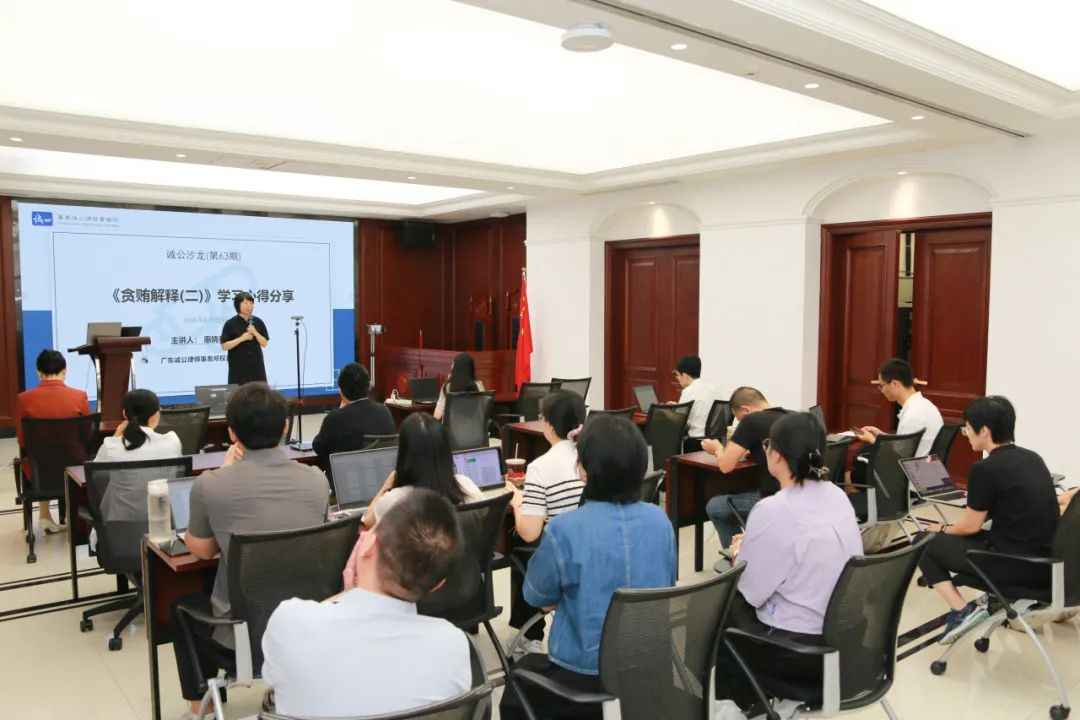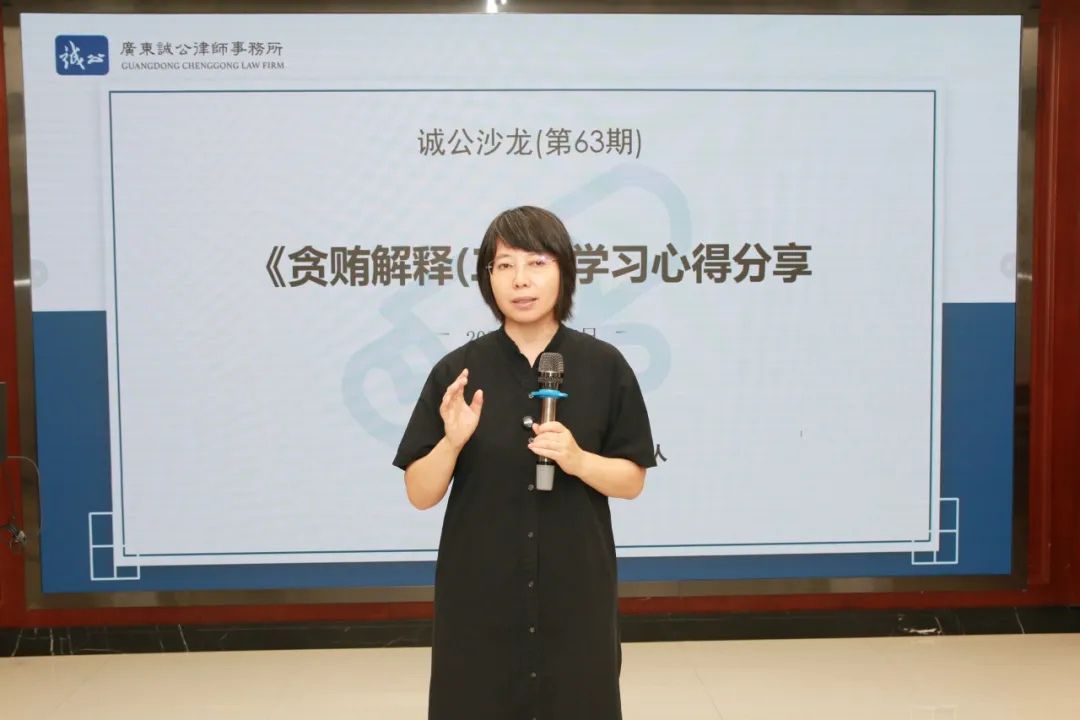
The 63rd Chenggong Salon of Guangdong Chenggong Law Firm was successfully held on June 25, 2026. The lecture was delivered by Lawyer Hui Xiaoli, Equity Partner of the firm. The session was rich in practical knowledge and sparked heated discussions on site.
Lawyer Hui divided the sharing of learning insights at this salon into four parts.
Part One: Updated Amount Standards for Embezzlement and Bribery Crimes (Articles 1 to 8). Lawyer Hui made a comparative analysis of the old and new amount standards stipulated in Articles 1 to 7 of the Second Judicial Interpretation Concerning Several Issues on the Application of Law in Handling Criminal Cases Involving Embezzlement and Bribery. She clarified the new adjustments to the threshold for criminal liability and corresponding sentencing ranges for all charges related to embezzlement and bribery. She also pointed out that the revisions under Articles 1 to 8 have quantified the monetary thresholds for crimes specified in Chapter VIII of the Criminal Law, filling the previous regulatory gaps.
Part Two: Identification Rules for Bribery Crimes (Articles 11 to 17). The rules cover bribery through business opportunities, bribery based on anticipated proceeds, and brokerage bribery. These new provisions were formulated to address increasingly complex criminal patterns arising from evolving and sophisticated economic activities.
Part Three: Identification Rules for Crimes of Misappropriating Public Funds and Illegal Dividing of Public Assets (Articles 9, 10, 18 to 20). In this section, Lawyer Hui emphasized two distinct forms of the crime of misappropriating public funds: falsification and interception. She noted that heavier penalties shall apply where public funds are lent to other entities resulting in substantial losses, and combined punishment for multiple crimes shall be imposed for concurrent acts of misappropriating public funds to offer bribes and dereliction of duty.
Part Four: General Provisions: Voluntary Surrender, Return of Illicit Gains, Recovery of Stolen Property and Application Validity (Articles 21 to 24). This segment centers on conveying updated judicial philosophies. It clarifies that confessing other crimes of the same nature in duty-related offenses may constitute quasi-voluntary surrender under specific circumstances, signaling a potential legislative direction where voluntary surrender could also be recognized for multiple crimes of the same type in future legal revisions. It further specifies four scenarios that qualify as active return of illicit gains: full restitution of illegal proceeds, active cooperation in asset recovery with most illicit assets sealed, seized or frozen, full restitution of personal illicit shares in joint crimes plus voluntary additional repayment, and restitution made by the offender’s relatives or friends on their behalf.
CHENG
At the end of the salon, Lawyer Hui pointed out that the Second Judicial Interpretation on Several Issues Concerning the Application of Law in the Trial of Criminal Cases Involving Embezzlement and Bribery and the original Judicial Interpretation on Several Issues Concerning the Application of Law in the Trial of Criminal Cases Involving Embezzlement and Bribery are complementary rather than mutually exclusive. Provisions unamended by the new judicial interpretation shall remain in force under the original interpretation. Where no relevant judicial interpretation existed at the time of the criminal act, the new interpretation shall apply. In case of inconsistency between the new and old judicial interpretations, the principle of applying the old law with lighter punishment shall prevail. Cases that have been closed before the implementation of the Second Judicial Interpretation on Several Issues Concerning the Application of Law in the Trial of Criminal Cases Involving Embezzlement and Bribery shall no longer be governed by this interpretation.
CHENG
At this salon, Lawyer Hui unpacked and reasoned through the core issues of the Second Judicial Interpretation on Several Issues Concerning the Application of Law in Handling Criminal Cases Involving Embezzlement and Bribery. Drawing on her extensive practical experience in public prosecution work at procuratorates and criminal defense practice as a lawyer, she translated rigid legal provisions into tangible risk reference standards.
We hope to take this salon as a new starting point, keep delving deep into the fields of duty crime defense and compliance practice, respond to the demands of the times with professional expertise, and uphold faith in the rule of law with dedicated craftsmanship.
C
CHENGGONG
Speaker of This Session